Mechanical
Provide the receiving-tool or placement drawing, gasket support, clearances and required orientation. Define acceptable deformation through the complete transfer, with access and surrounding equipment identified.
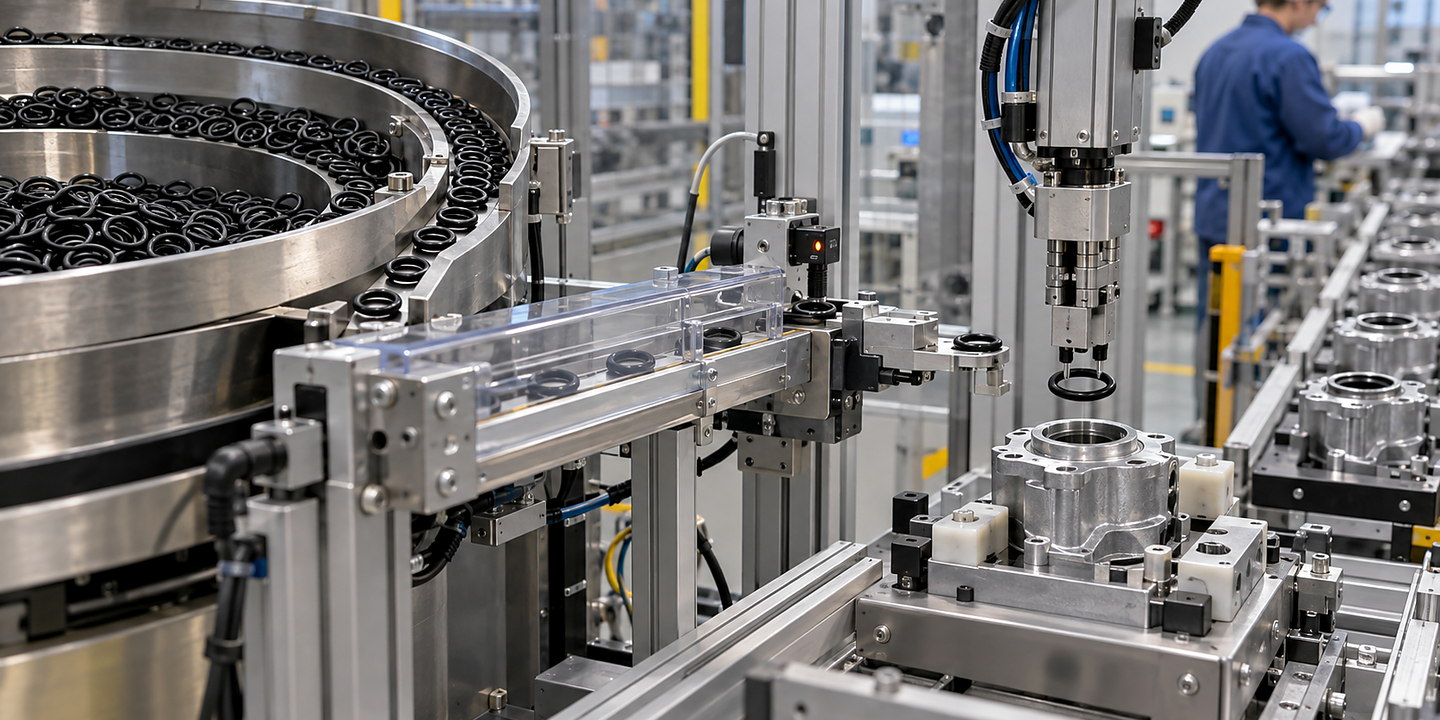
Define gasket-feeding integration around the actual placement interface, support, clearance, readiness confirmation, acceptable deformation and documented recovery.
Define the gasket condition and orientation required at the actual receiving station, including support and available clearance. Agree how that station confirms a gasket is ready and when transfer is accepted. Include stuck pairs, folded gaskets, replenishment and documented recovery in the complete line trial.
Use the representative gasket range and component and line checklist. Readiness confirmation is a requirement to agree; it is not evidence that a particular sensor or controller is already included.
Plan gasket feeding systems around real component variation, bulk condition, orientation, usable delivery rate and the downstream interface. Discuss representative part trials with Sorting Solutions. Your integration review should connect bulk condition and replenishment method, required orientation and delivery rate and the people who run the process.
Discuss your application

Provide the receiving-tool or placement drawing, gasket support, clearances and required orientation. Define acceptable deformation through the complete transfer, with access and surrounding equipment identified.
Identify the proposed devices and supplies, isolation, protective arrangements and cable routes for the actual layout. Agree responsibilities with the installation team rather than assuming an electrical interface from a part trial.
Agree the request, ready, transfer and fault states between feeder and receiving station. Define the response to an unready station, stuck pair, folded gasket or interrupted demand and retain the documented recovery sequence.
Review access, stop behaviour, isolation and authorised recovery for the actual installation with the responsible team. Keep these requirements separate from the trialled gasket-handling result; no safety-function or compliance claim is made.
Identify the gasket and setup revision with the trial and fault record. Retain accepted delivery, stuck-pair/folded results, damage observations and first accepted handover after recovery in the agreed evidence format.
Plan loading, replenishment, authorised clearance, cleaning, maintenance and changeover responsibilities. Include checks that the first gasket after recovery or a setup change meets the agreed condition, orientation and readiness requirements.
For Gasket Feeding Systems, your team can review each stage before the complete installation is put into routine use.
Share representative production components and the downstream interface, including the normal range for component geometry and variation for flat & shaped gasket feeding and the difficult surface, fragility and entanglement behaviour cases.
Compare suitable methods and use focused trials to show how each option performs against bulk condition and replenishment method.
Connect the equipment to your line, services and controls while resolving required orientation and delivery rate for day-to-day operation.
Confirm escapement and downstream pick interface, then complete and record jam, damage and recovery acceptance checks before your operating team takes over.
For your application: check bulk condition and replenishment method, required orientation and delivery rate, escapement and downstream pick interface, and jam, damage and recovery acceptance checks as part of the complete line trial.